
September 20, 2016
Fall color is beginning to creep into the trees and ferns behind the garden, a process that helps me adjust to the inevitable.
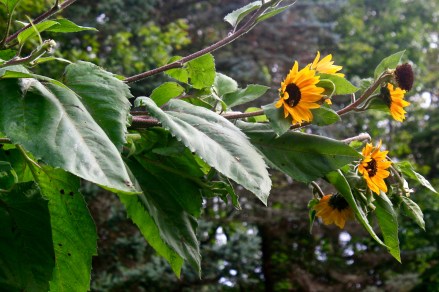 The biggest changes from last week are the sunflowers (Helianthus annuus) have been decapitated by a hungry squirrel and the heart-leaved asters (Symphyotrichum cordifolium) have begun to bloom on the far left and in the middle (in front of the zinnias and behind the coneflowers). By next week, they will be big lavender clouds, airy and light.
Many gardeners around here eschew this lovely native, but I find it has great merit in the garden if you have the space for it, as it can grow quite large.
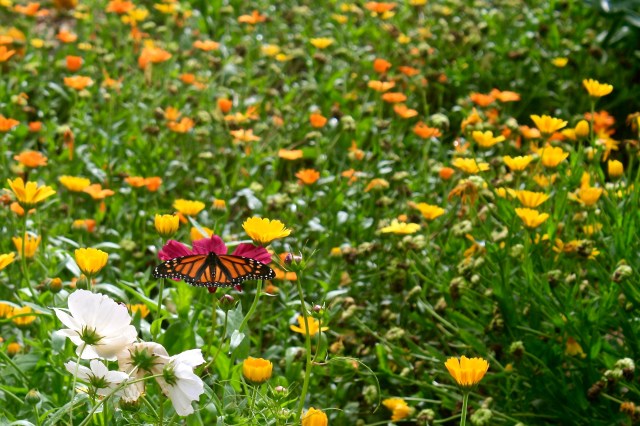 While I was taking these photos this morning, I was graced with the presence of yet another migrating Monarch butterfly. It felt like a blessing, bringing a ray of hope now that I have seen half a dozen this summer, whereas the past few years I have seen none. Fellow gardeners, continue to lead the charge for bringing this imperiled species back from the brink of extinction! Learn more by clicking the link above.
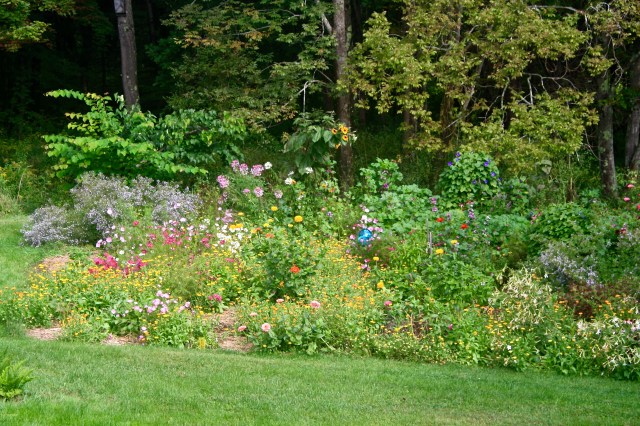 Continuing to provide color are purple, pink and white cleome (C. hassleriana), white, dark and light pink cosmos (C. bipinnatus ‘Sensation Mix’), zebra mallow (Malva sylvestris ‘Zebrina’) and zinnias (Z. elegans ‘County Fair Mix’). Calendulas (C. officinalis) are mixed through the left middle. Purple morning glories, on a teepee at the back, brighten the early hours.
On the right side, the white phlox (P. paniculata) is finishing, while the stalwart white flowering tobacco (Nicotiana alata), pink coneflowers (Echinacea purpurea) and lamb’s ears (Stachys byzantina) continue to do their thing.
I’m linking with Cathy at Words and Herbs, joining participants taking weekly photos of the same garden over the course of the growing season to note its evolution.
Below are some of the previous views for comparison:

April 1, 2016

June 11, 2016

June 28, 2016
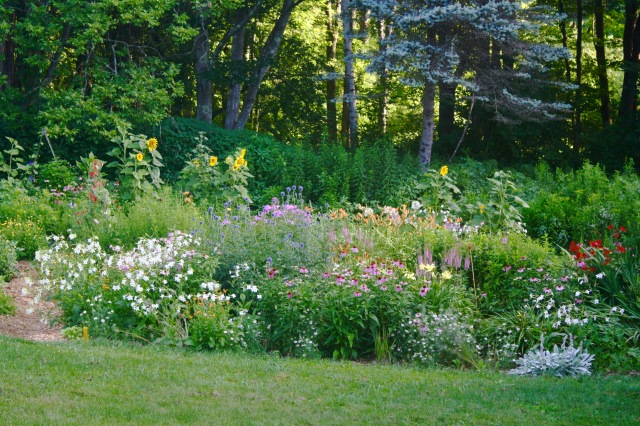
July 26, 2016
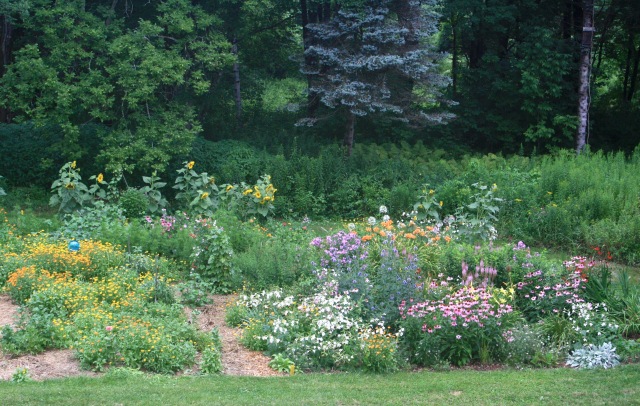
August 2, 2016
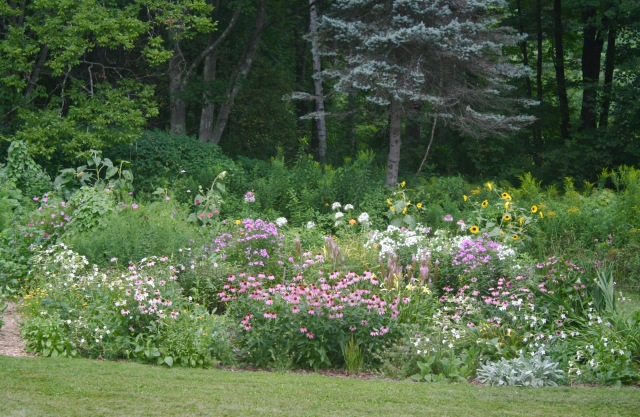
August 16, 2016
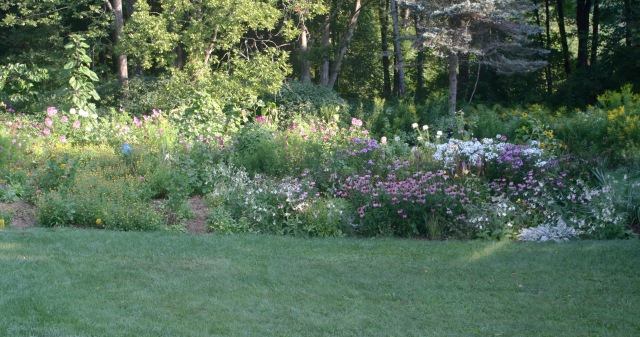
August 23, 2016
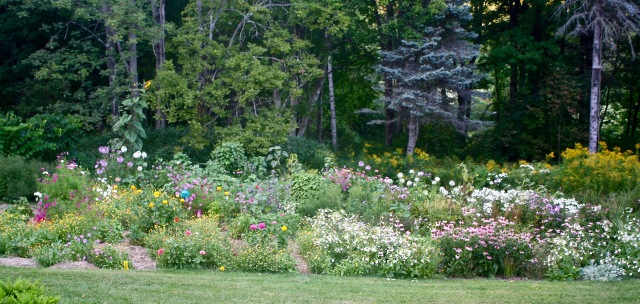
September 6, 2016
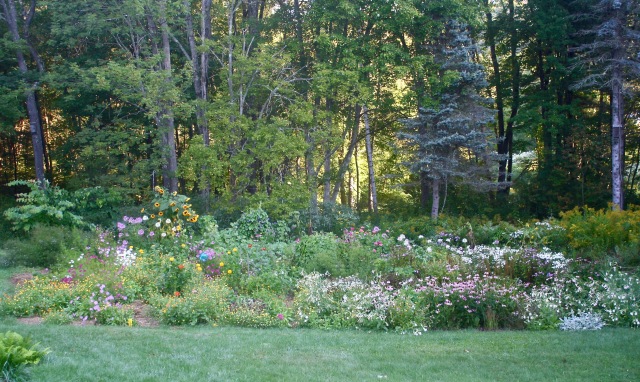
September 13, 2016

 This is my first foray into joining Christina at


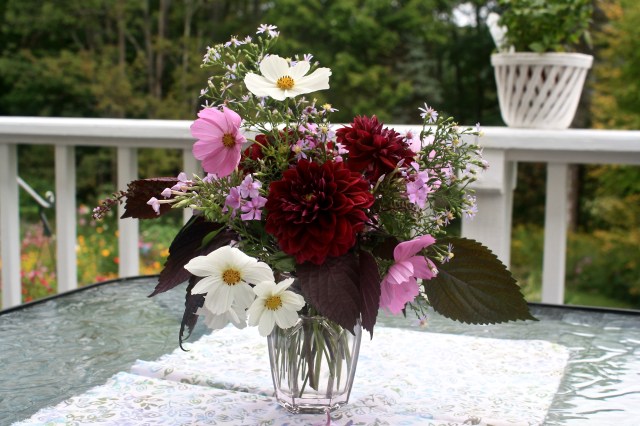 Dahlia ‘Voodoo’ is casting its magic over the garden these days and I’m spellbound by its deep, rich burgundy color. Naturally, I must share them!

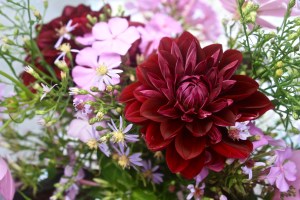 Heart-leaved aster (Symphotrichum cordifolium) provides the filler and shiso (Perilla frutescens), the perfect foliage to play off the dahlias.
 The amethyst crystal Art Deco vase was from my mother-in-law’s collection.
 The Bridge of Flowers
 There is a log book at each end and I’ve seen entries from all over the world – Europe, Asia, Africa, Australia and New Zealand.
 The Bridge of Flowers is open from April through October and always has lots in bloom, from early bulbs to late asters and chrysanthemums.


 Even though I think not much has changed, I look at last week’s photo and see that of course, change is constant. The biggest change is the sunflower has begun to bloom and it is a beauty. I featured it in my
  Along the back, purple, pink and white cleome (C. hassleriana) mix with white, dark and light pink cosmos (C. bipinnatus ‘Sensation Mix’), and dots of zinnias (Z. elegans ‘County Fair Mix’).
 We’ve had several nights this past week where the temperatures dipped into the low 40sF (5C), which the heat lovers, like zinnias, do not like. I’m savoring the last of my garden blooms, as I know the end will come eventually.


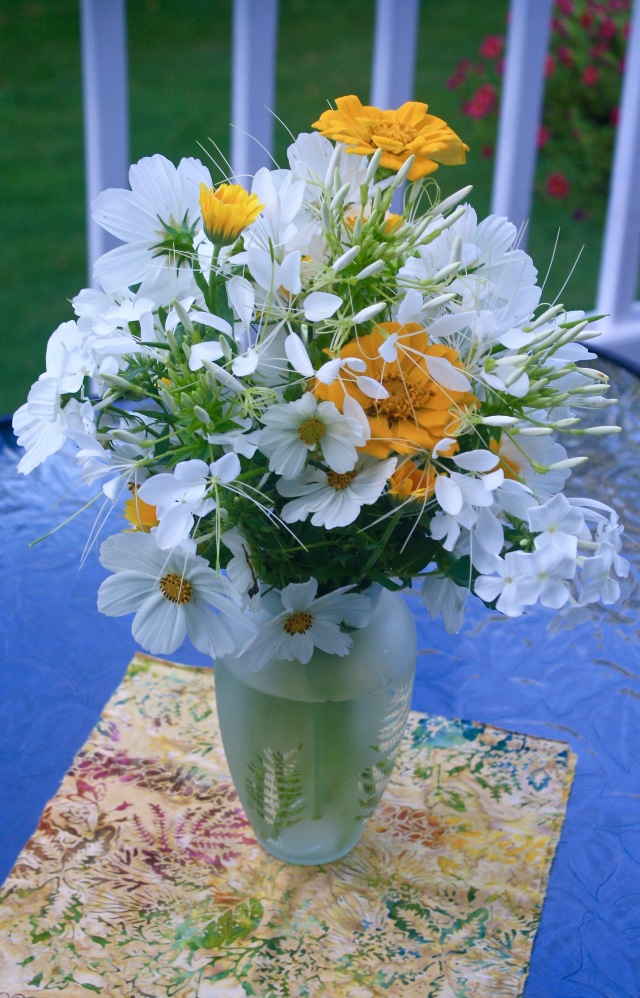 I’ve been enjoying the purity of the white cosmos (C. bipinnatus ‘Sensation Mix’) in my garden, so I thought I’d make an arrangement using them along with white phlox (P. paniculata) and white spider flower (Cleome hassleriana). Yellow zinnias (Z. elegans ‘County Fair Mix’) and lemony calendula (C. officinalis) add to the fresh look.


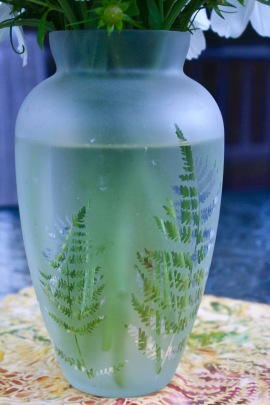 My frosted, white glass vase, etched with ferns, is one of my versatile favorites. I picked it up at the free table at our transfer station a couple of years ago. (This past Saturday, we picked up a nearly new espresso maker. I love that place!)
 Thanks to Cathy at


 Eliza Waters