 As you probably are aware, April 22 is Earth Day, when we celebrate our beautiful Mother Earth. However for gardeners, I think every day is Earth Day, in that we demonstrate caring for the planet through our gardens.
 It distresses me that our Earth is still in peril despite measures taken since the first Earth Day in 1970. Our lifestyle, which many take for granted, creates greenhouse gases and nearly every action puts more into the atmosphere, adding to climate change. Even the smallest things we do as individuals, when spread across many shoulders, leads to big impacts for better or worse.

Seeking ways to reduce my carbon footprint, I wondered about ways to reduce in my gardens, other than carbon absorbtion facilitated through plants. Rototilling garden soil releases greenhouse gases, not just the exhaust from the machine doing it, but gases stored in the soil itself. No-till gardening uses mulch, which reduces the need to weed and cultivate, adds organic matter to the soil and holds these gases within the soil. Microorganisms and fungi within the soil also are supported and this enables even more carbon retention.
 Costly pesticides and fertilizers are petroleum products, so practicing organic methods are another way to reduce. The Amish, who don’t use chemicals, actually have greater yields per acre than their neighboring farmer up the road who does.
An estimated 17% of all fossil fuel consumed in the USA goes for food growing, harvesting, processing, shipping, packaging and distribution. Organic production cuts this by about 30%. In the U.S., the average bite of food travels 1,500 miles from farm to table. Raising food at home or buying local organic food saves significantly.


Meat production has a larger carbon footprint than vegetative production, since animals produce methane and consume grain, adding an extra step in the food chain. If you make a couple of meals each week meat-free, eat 10-20% less at every meal (which sheds those extra pounds you may have been meaning to lose anyway), you’ve changed the world!
 Nearly every single thing we consume has a carbon footprint. By looking at what we consume and asking ourselves how we can reduce, each of us can take small steps, which together add up to make a huge impact. Our and future generations’ lives will be affected by the actions we take today. Make a pledge now in honor of Earth Day to change your world. For more ideas, visit http://www.earthday.org/take-action/


 With a week of above normal temperatures, at last my garden is beginning to grow and bloom. Last week everything was tightly budded, but this week is a different story. I had cut a few branches of Japanese quince (Chaenomeles × superba) to force and then this weekend the forsythia (Forsythia × intermedia) began to bloom along with a few pink hyacinths (Hyacinthus orientalis). I put in a few dried black birch catkins (Betula lenta) for accent.







 Even though our local bear reliably shows up sometime in the first week of April, I am reluctant to take the feeders in. Well, he/she is right on schedule, having paid us a visit last night. So ends bird feeding for another season.

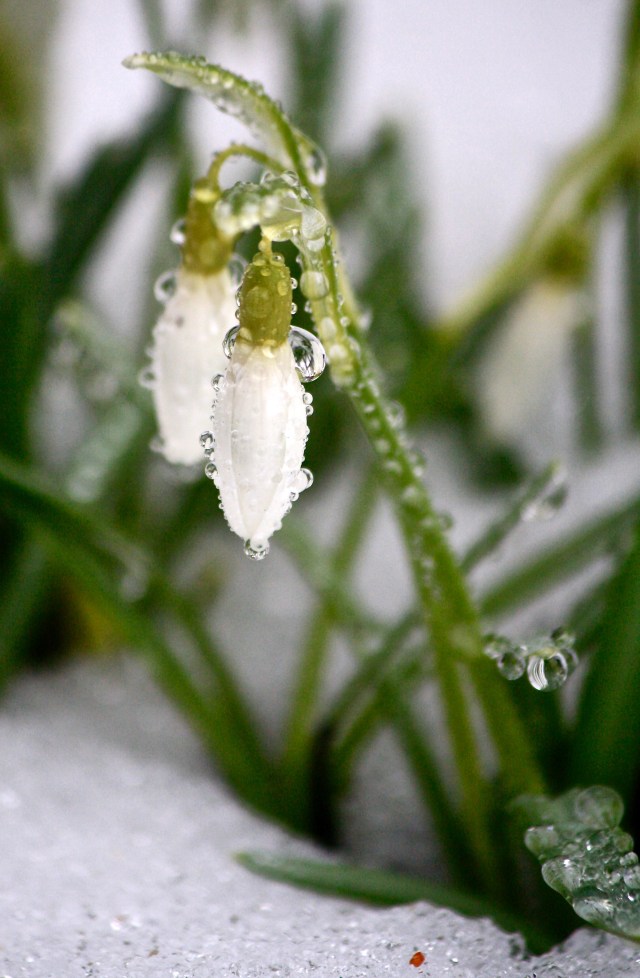
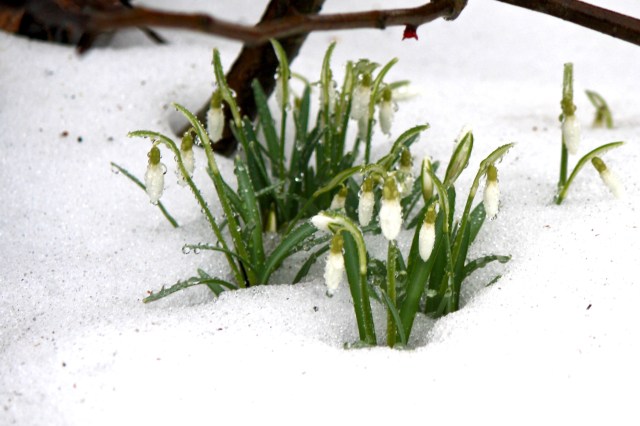
 As you can see, we still have snow! Four inches of ‘mixed’ precipitation fell on Friday into Saturday as Mother Nature played her April Fool’s joke. However, it is melting rapidly on this sunny day, where our high is 47F (8C). While this may not sound warm to many of you, it is downright balmy to us!
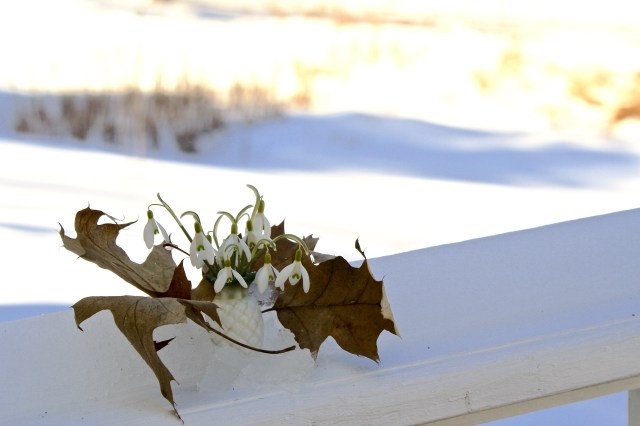 Placed into the mushy snow on the deck railing, I’ve filled my little pineapple vase with snowdrops (Galanthus nivalis), and surrounded them with oak leaves that sheltered them as they emerged. The snowy garden in the background attests to what remains. Below right is a photo taken of the back yard during the storm: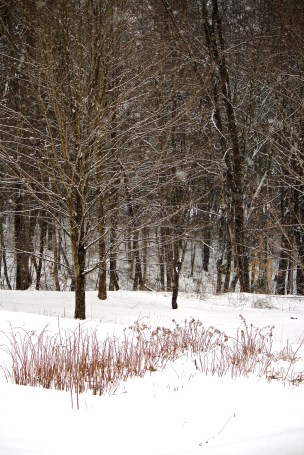


 Thanks to Cathy at