I’m joining Robin at Breezes at Dawn for her annual Walktober meme. Anyone who wants to share a seasonal walk is encouraged to join posting by Oct. 28. Click the link for details and watch for the round-up post at the end of the month to see where other folks have been walking. A beautiful way to armchair travel through October.
For my fourth Walktober, I wanted to share a place that is very special to me. Hawley Bog, a 65-acre preserve in Hawley, MA, is one of the last examples of a high-altitude acid bog in New England. A fragile wetland with a floating mat of peat 30 feet thick over open water, it hosts rare plant species that thrive only in bog habitats, including many species of orchids, carnivorous bladderwort, sundew and pitcher plants.

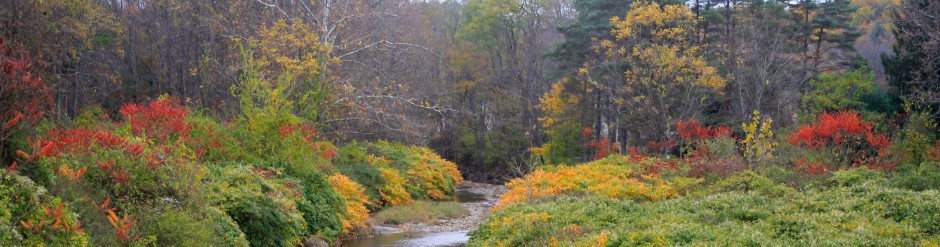
Red maples
Even though I’ve lived here most of my life, I only just discovered this spot a few years ago and it has become a favorite. Desolate, remote and unspoiled, I am grateful that it has been preserved by a collaboration between The Nature Conservancy and the Five College Consortium, who use it as a teaching and research field site.
Next to the small carpark, there is a kiosk with information about the bog and an aerial map of the short trail. While only half a mile or so round trip, I find this site sacred, a church of Nature if you will, and walk it meditatively, shinrin-roku style, immersing myself in this ancient wilderness. I can easily spend a couple of hours there.
Entering the forest, there is a hush and one can feel there is something indescribably different about this place. Red maple, birch and beech trees line the path. Pine, spruce and hemlock overhang ferny glades.
A short way in there is another info board showing plants one might encounter and a sign-in box to let researchers track visitors. Once the boardwalk begins, because of the sensitive habitat, only two people are allowed per section.
The day I visited I had the place to myself, seeing only birds (migrating White-throated Sparrows, resident Chickadees, Juncos, Blue Jays and Ravens, which flew overhead calling out their distinctive ‘cronk’), as well as insects and plants.
Bog rosemary, laurel, cranberry and winterberry thrive here. Out on the bog, the plants become stunted. Being at high altitude, the wind nearly always blows, making it quite frigid during the cool seasons and arctic conditions in winter.
While I took hundreds of photos, I had to limit myself to these few. I hope you enjoyed this walk as much as I did!


Forty-three miles away as the crow flies from where I stand, a view of Mt. Monadnock in New Hampshire over dappled fall foliage.
Dahlia ‘Moonstruck’ and Helianthus ‘Italian White’ are perfect in each others company in this week’s arrangement. Creamy-white with a touch of lemon, I placed them in a milk jug that once belonged to my grandmother.
Three Abyssinian gladioli (Acidanthera murielae) were added for accent. This is the second year I have grown them and while last year yielded no blooms before frost, this year they managed three. I’m doubting whether to grow them again, as they barely make it to frost. Being a zone 7-11 bulb, our summer is just not long enough for them. However, a single blossom can deliciously scent a room, so perhaps I’ll continue to try. Maybe start them early inside in pots? Anyone else have this problem?


Even though it feels summery with warm rain and humidity from Tropical Storm Nate, the light and changing leaves are definitely autumnal.

Dahlia ‘Tiki Torch’ is the fiery star of this week’s IAVOM, along with Sunflowers (Helianthus annuus ‘Italian White’) and golden orange Zinnia elegans ‘Sprite.’
Lastly, just because my Sweet Peas (Lathyrus odoratus ‘Royal Mixed’) are still blooming (amazingly non-stop all summer), I’ll share my kitty-in-the-flowerbed pocket vase filled with them. Such fragrance!