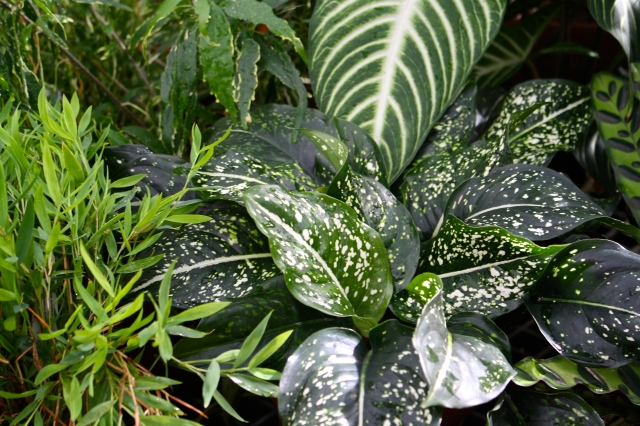
 Perhaps my recent post, Breathe Easy, inspired you to buy a few houseplants to purify your air and decrease toxins that off-gas from carpets, furniture, paint and cleaners. “Now what?” you might ask. Many feel befuddled when it comes to caring for plants, claiming they kill plants and worry past disasters are doomed to continue into the future. Not so!
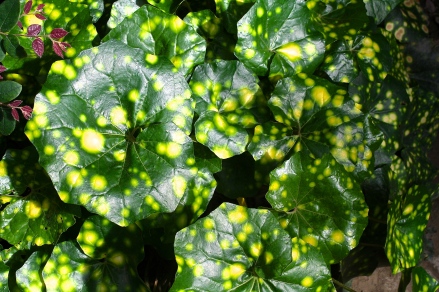 Plants are living things and require care just like pets do. If you’ve ever owned an animal (or an animal owned you), you can easily learn to tend these very undemanding ‘pets.’
Things to keep in mind are temperature, humidity, light, soil moisture and fertilization, which I will outline in detail below.
The best plants for cleaning the air are tropical in origin, requiring a range of temperature, which luckily, coincides with the range we humans find comfortable as well: 60-75F (15-24C).
Under ideal conditions, these plants will respire and grow rapidly, thus increasing their cleansing capabilities. So, while cacti and succulents look nice and thrive on total neglect, their slow growth makes them poor candidates for air cleaning, thus I will focus this post on tropical plant care.
 Most tropical plants live in lush, humid, jungle conditions adapted to low light, high humidity and daily rainfall that evaporates almost immediately, repeating the cycle every day. While the plants in the NASA study can tolerate lower humidity levels often present with home heating and cooling, they thrive in moist air.
 To increase humidity around your plants you can use an atomizer to mist the plants once or twice a day. Another method is to place a large tray of pebbles filled with water beneath the plant saucer. Placing the pot directly on the pebbles is not recommended as soil will sift into pebbles reducing their evaporation effectiveness and roots will grow out of drainage holes taking over the tray.
These plants require indirect light, such as an average room receives. In winter, they may be in a sunny window, but summer sun may be too strong and would need to be filtered by a curtain, blind or moved away from direct light. If the room receives little or no light, a LED or fluorescent bulb can provide enough for survival. Special, broad-spectrum bulbs offer optimal light conditions, but are not necessary.
 Soil moisture is where most failures occur, generally from overwatering. Using potting soil amended with 50% perlite and activated charcoal (available at garden stores) will help keep the soil aerated and avoid root rot. Roots need air as much as the green parts do.
The trick is to learn when to water – too often or not often enough will have the same result – death.
Before watering a plant with room temperature water, touch the soil to see if it is slightly dry to the touch. If it is moist, check again in a day or two. Size of plant and pot, plastic or clay, as well as room conditions, will determine how quickly it needs watering. For instance, in winter, I water maybe once every 7-10 days, whereas in the other seasons, it may be every 3-4 days. You can’t tell unless you touch first. It may require checking daily, but eventually, you will be able to predict each plant’s needs. Water until a little drains out of the bottom of the pot; remove any excess in saucer after a half an hour. Never allow water to sit in saucers, as it can lead to root rot.
 Lastly, fertilizer needs to be applied to keep plants vigorous. There are chemical fertilizers like Miracle-Gro® and organic ones like Neptune’s Harvest®, the choice is up to you. Pick one formulated for houseplants, generally in a 5-10-5 (nitrogen, phosphorus, potassium) ratio. Follow directions on the label. In general, apply every 2-4 weeks or if that is too hard to keep track of, you can dilute the formula ¼-strength for every time you water.
 Keep plants free of dust by spraying them with tepid water from a kitchen faucet sprayer or for larger plants, in the shower. Once a year, take plants outside, turn out of their pots, wash away old soil with a hose, trim off dead roots, prune top growth (if excessive), and place in a larger pot (only if pot-bound) or divide in two, increasing your number of natural air cleaners for your home or to give away. Always pick a pot that is sized only slightly larger than the existing root ball.
With a little care, plants will reward you many times over with their beauty, serenity and health-giving properties. Which I believe is well worth the effort!











 Eliza Waters