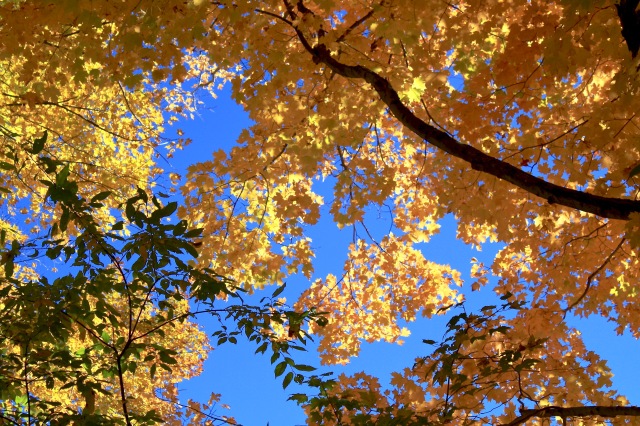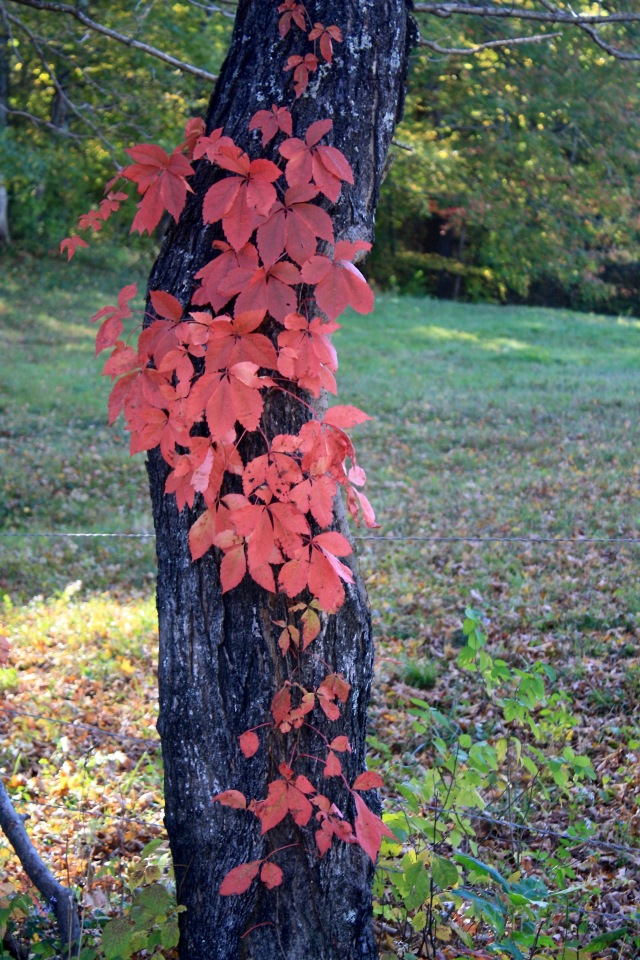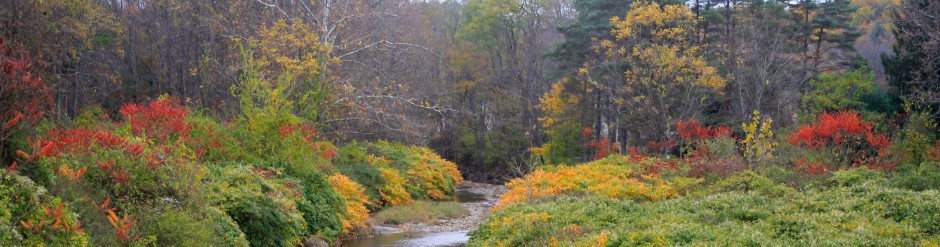
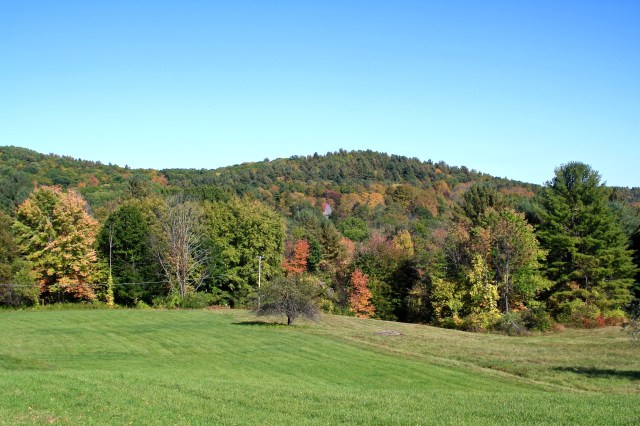
 As I head out on my walk through our woods and along our little river, the air is soft and warm, a perfect Indian Summer day in the upper 60sF (20C). A few soft clouds drift in a Wedgewood blue sky. There is a light breeze and occasional gusts tug at the orange and yellow leaves that lift and swirl, a golden rain of parting. Cherry tree leaves, all shed but the last ones that cling to the terminal end of every branch, flutter like golden pennants at a joust.
 Backlit by the sun, blueberry leaves are carmine splashes against a gray and brown background.
Juncos twitter and titmice call a nasally ‘dee-dee-dee’ from the undergrowth with a sudden flutter of wings as I draw too close for their comfort. Flocks of white-throated sparrows whistle and call as they fervently seek seeds throughout the weedy undergrowth to fuel their journey southward.
 As I reach the river and settle into an Andirondack chair that gives me a view up and downriver, I see a goldfinch cross the sky in its undulating flight, twittering with each swoop. Turkey vultures ride high upon thermals, executing lazy circles as they drift on the warm breeze.
 Stalks of dried Joe-Pye weed, leaves a dark, chocolate-brown, rustle stiffly in the wind. Topped by clouds of soft-gray, fluffy seeds, they await a gust to carry them airborne to new horizons.
 Lining the banks, rust and gold knotweed reflect in the rippled pools, along with shimmering patches of blue sky and wiggly, dark lines of locust tree trunks. Flames of sumac rise here and there above taupe-colored knotweed seed heads, a frothy sea recently frosted, its rampant growth arrested. I follow the repeated chipping of a brilliantly plumed male cardinal as he sails past and disappears into the thicket.
 Crows caw and scold constantly, annoyed at the migrant, swirling vultures and the occasional hawk, which always elicits a battle cry and chase. This past week, flocks of Canada geese heralded their arrival at dusk to the cornfields across the hollow, skimming low over the house, poised with feet out, like planes with gear down for landing, ready to alight.
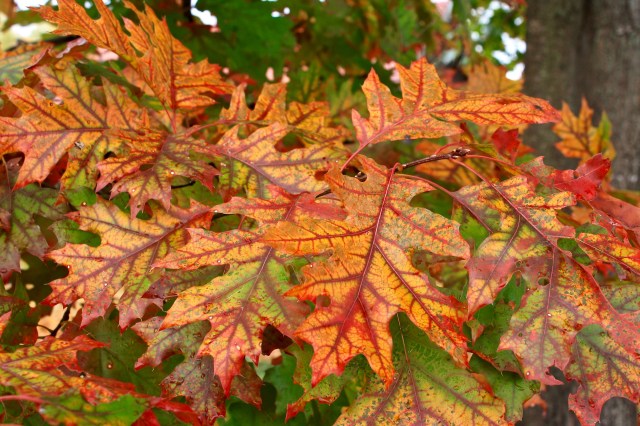
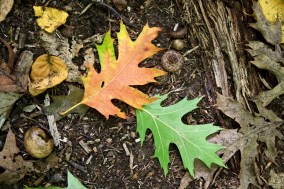 The air is pungent, redolent of spice and earthy decay. The landscape pauses at peak and moves on, heading towards dormancy. Maple, birch, cherry and ash have shed their raiment, pulled down by the wind. Oaks are coming on in russet and gold. Sycamores turn a yellow-tinged, rusty-brown; its coarse leaves rustle and litter the ground like discarded paper plates after a street fair. The colors of late autumn, after the flashy maples have passed, are subtler. They do not shout loudly, but quietly await recognition and appreciation. They are the wallflowers at the dance, yet they possess their own virtues.


Honeysuckle and rose briar are dark mounds tucked against the wooded edge while glowing, golden feathers of sumac leaves rise above them, looking like sloping palm trees on a tropical beach. Ash trees, shorn of leaves with only their petioles left behind to dry, remind me of tufts of sparse pine needles, which the last rays of the sun paint a soft, coral-pink.
A dozen or more crows come in to roost on the opposite hill. They wheel and caw, establishing kinship perhaps, alighting and arising again from the pine and oak that top the ridge, before finally settling in for the night.
 Leave the human world behind
Let Nature call your name and
Hold you in Her cupped hands
 I’m joining Robin at Breezes at Dawn for her annual Walktober meme. Anyone who wants to share a seasonal walk is encouraged to join in by posting by Oct. 25. Click the link for details and to see where other folks have been walking.



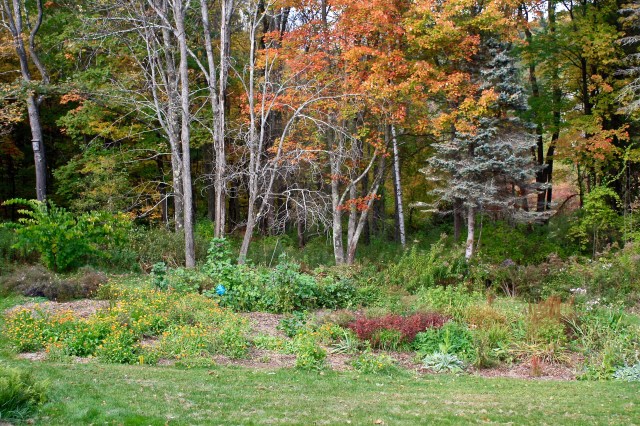

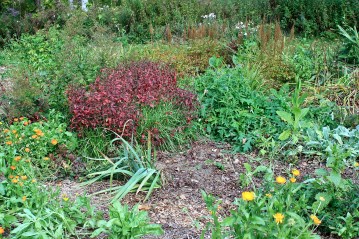
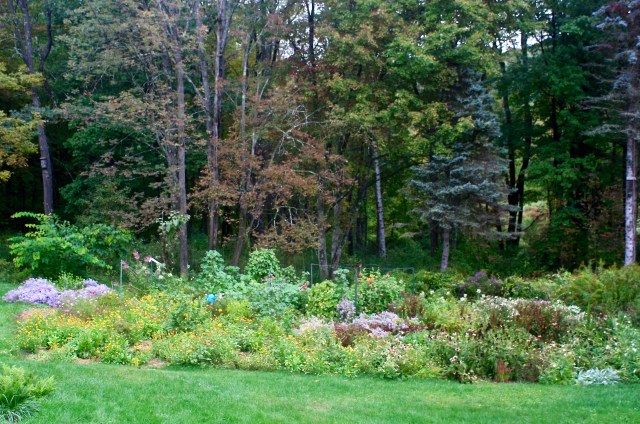
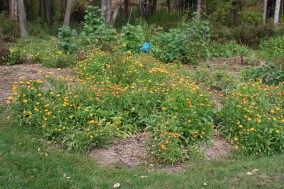 The half-hardy calendula (C. officinalis) continue to put forth gold and orange blossoms, for which I am grateful. The past two afternoons, a late migrating monarch has come to feed, so I am glad I had something to offer it.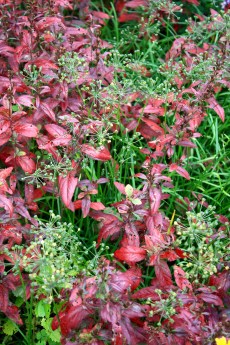
 The globe thistle (Echinops ritro) continues to push forth its new flower buds; it just might bloom before the deep cold sets in.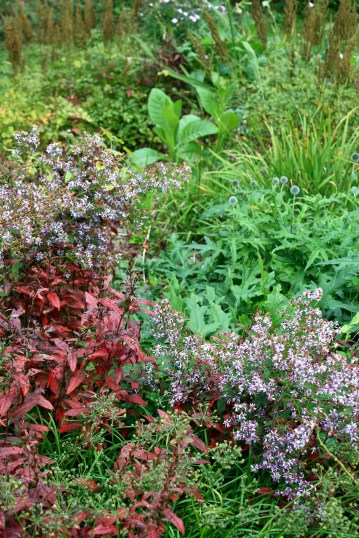
 As the coneflower (Echinacea purpurea) self sows a bit too enthusiastically, I’ve cut back most of the seed heads and moved many plants to the half-wild herb bed next to the field, where it can go as crazy as it wants.
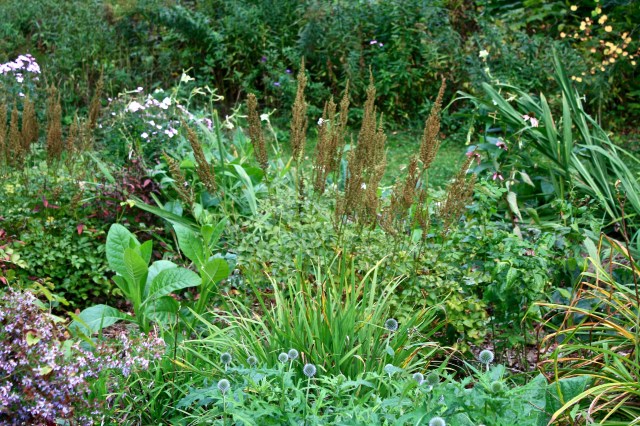 The astilbe seed heads are rusty brown, the daylily foliage turns golden brown and some late-sown white flowering tobacco (Nicotiana alata) bloom here and there.

 My sunflower pocket vase, another from my collection of hand-painted pottery made in Ecuador by
  The past week has seen several frosts that have ended my annuals, deepened the colors of perennials such as Sedum ‘Autumn Joy’ and leaves of the maple, ash and birch trees around my yard.
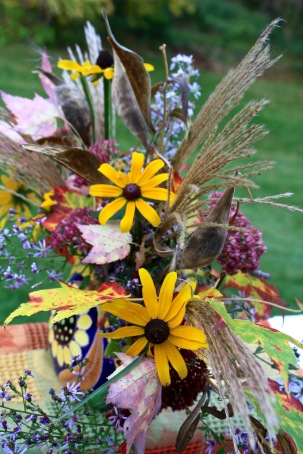 Black-eyed Susan (Rudbeckia hirta) have sent up a flush of new blooms and used here, reflect the sunflower on the vase. A few dried milkweed pods (Asclepias tuberosa) signal the end of the garden year.
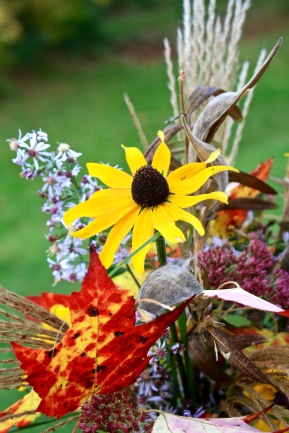 While the heart-leaved asters (Symphyotrichum cordifolium) in my main garden are done blooming, the woodland edges still have plenty to offer and I never tire of using them as filler. The harlequin foliage is swamp maple (Acer rubrum) and maiden grass (Miscanthus sinensis ‘Gracimillis’) offers a vertical splash.
 Thanks to Cathy at