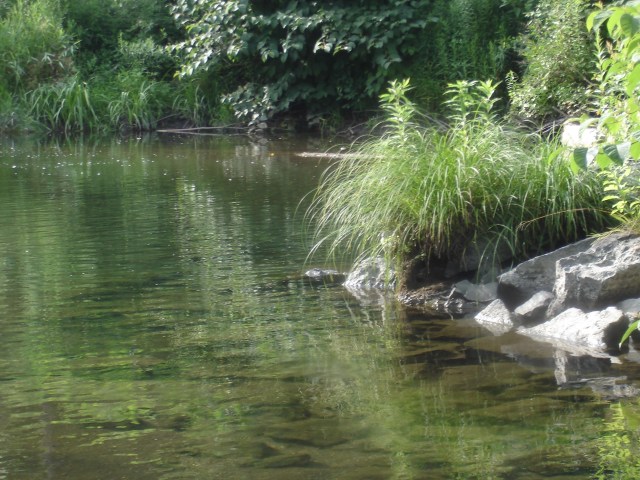
 When the days get hot, I like to take a cooling wade along the shady banks of the river behind our house. Some would call this a creek or stream, and with the lack of rain this
 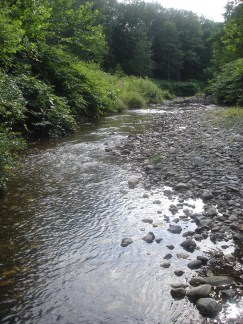 summer, it’s lower than normal and less deep. Regardless, the water is clear, cool and refreshing for wading.
Every year, the river changes depending on how the water carves the bed as it passes through. Floods create dramatic changes. Hurricane Irene eroded whole banks and reconstructed the landscape. Smaller floods create deep pools, which later will be filled up again. This year, the bed downstream has small stones, gravel and sandy flats that make walking so much easier than slipping over 5-6″ cobbles. A good year for wading!

The dipping pool
There is a spot where the water has carved a hollow that is chest-deep. With a quick bend of the knees, I can completely submerge, giving me welcome relief from the heat.
It is peaceful here. I never see a soul, though the state highway passes not more than twenty feet from the bend. Foliage cloaks the banks, birds twitter and flit in and out searching for sustenance. I hear the ‘zee-zee’ call of cedar waxwings, the scolding cry of a catbird or the chittering of a belted kingfisher as it cruises upstream. Occasionally, a frog will plop in a quiet pool. I see animal tracks– deer, raccoon, mink and otter, letting me know that others use this river, too.

Fawn (left) and Doe (right) tracks

Blue Heron tracks with 2″ shard
 Little minnows nibble around my feet as I stir up sediment and debris with each step. Sometimes, I spy a crawfish, but mostly only pieces of them left behind after a critter has had a meal. Small invertebrates like caddisfly cling to stones and water striders skate the pools.
 The stones themselves are interesting to look at. They have tumbled for eons, their sharp edges long since smoothed. I love the ones that have veins of quartz running through them or the perfectly round ones that feel smooth in my hand. Slices of gneiss make great skipping stones.
Occasionally, I find a treasure, a broken piece of pottery or piece of glass worn smooth.
 Recently, tucked into the eddy formed behind a large stone, I discovered a 2-1/2″ shard from a Flow Blue dish. Flow Blue pottery dates from the early 1800’s, so it could be at least 150 years old. How long did it flow downstream to come to rest here for me to find?
I once found a piece of a Staffordshire plate with Franklin’s Moral Maxims printed on it, circa 1830’s. My kitchen windowsill is chock-full of finds and bowls overflow with broken pottery. Some day, perhaps I’ll make a mosaic out them.

Rail spike

Mourning dove?

Silvery checkerspot

Winged Monkeyflower (Mimulus alatus)
Up until the creation of a central town dump site (after the internal combustion engine became commonplace), folks threw their junk ‘over the bank,’ which included the river for those living along side it. It may be the origin of the term, ‘to throw something away,’ because the river would carry a lot of it out of sight.
Behind most old houses there lies a midden of discards. As kids, we loved to hunt for treasure in one behind our house. Parents today would be horrified to see their children pawing through broken glass, rusty cans and wire, but we were careful and I don’t recall any of us being injured or getting tetanus. We proudly showed our found treasures to our mother, who was just happy that we were occupied and weren’t underfoot. But I digress.

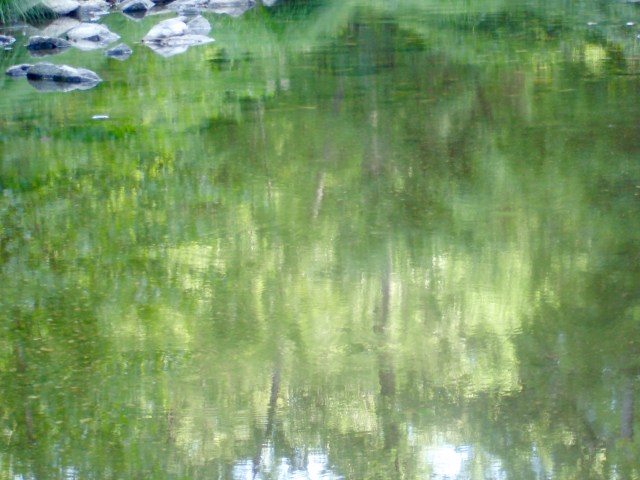
Green and gold reflections
Let’s go cool off at the river and see what we can find…
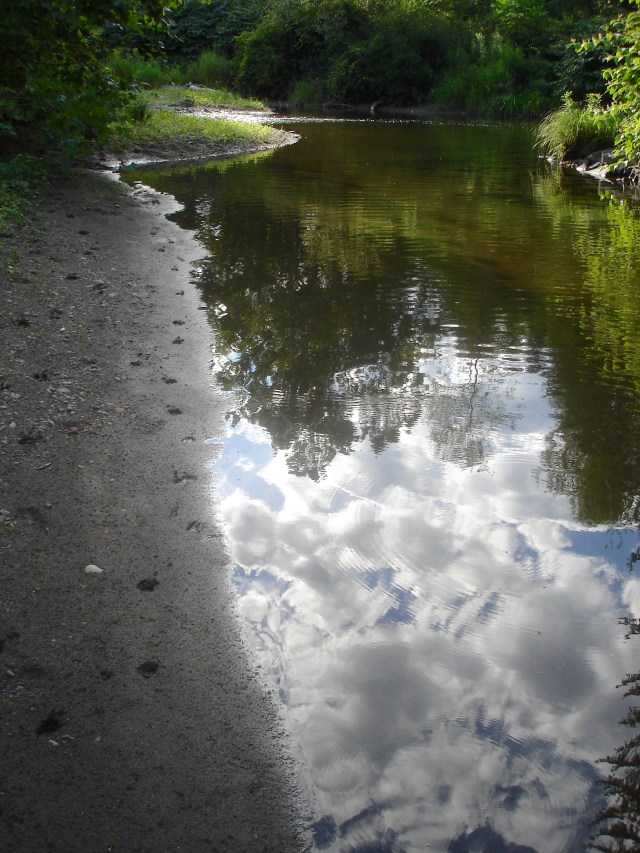
Deer tracks and reflections
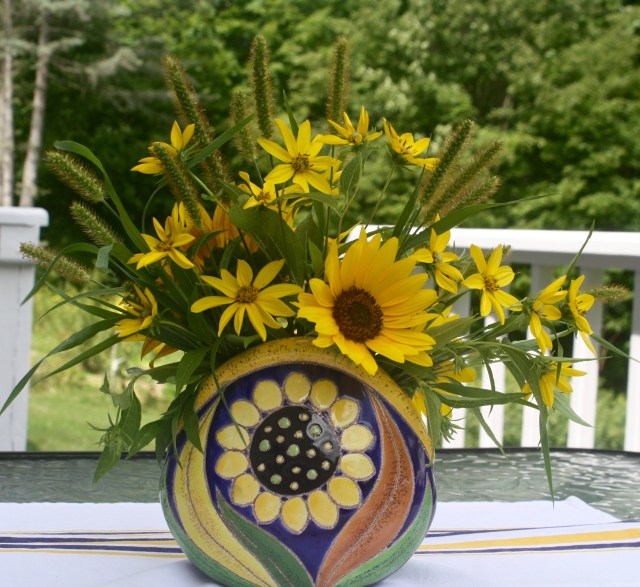
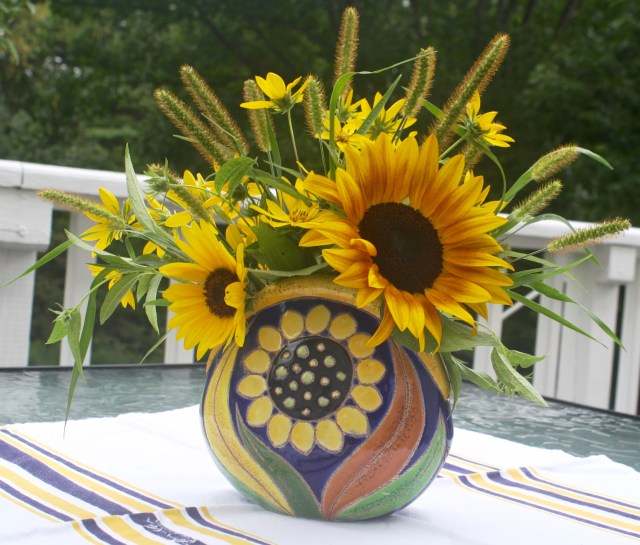 Seeing Cathy’s (Words and Herbs) sunflower vase last week, I was reminded that I hadn’t used my sunflower pocket vase this year. So, here it is, hand-painted in Ecuador by Artesa.
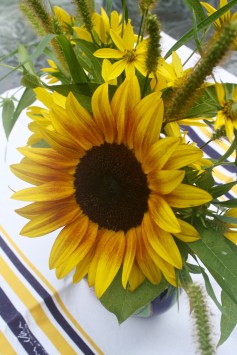 The large flowers are, of course, sunflowers (Helianthus annuus). I love the coppery blush on the largest one. No ID as it is from the CSA farm where we have we have a weekly share pick-up.
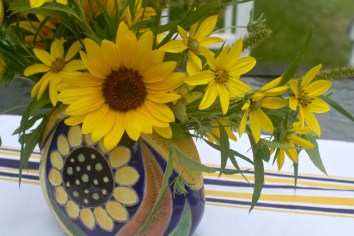 The yellow daisies are woodland sunflower (Helianthus divaricatus) and the grass is yellow fox-tail (Setaria pumila).
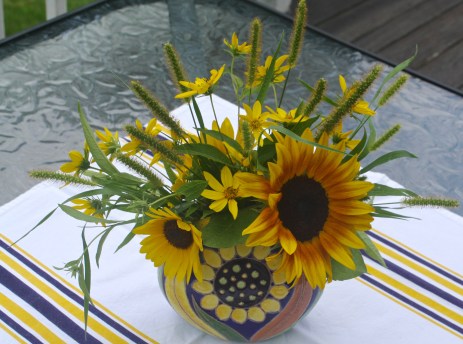 I recently learned that certain foxtail grasses create a problem with livestock and pets, because the barbed seed heads can embed in flesh, entering through ears and nose, where they can fester. Like in a horror film, some cases have resulted in death when the barb migrates to the heart or brain. The particularly troublesome species to watch for is Foxtail barley (Hordeum jubatum). Here is a short video to help identify it. Another is Canada wild rye (Elymus canadensis). If you have a dog that runs free in fields, click here to learn more.
 Thanks to Cathy at Rambling In the Garden, who hosts a weekly meme to showcase what is blooming in our gardens. Wander over to see what gardeners all over the world are arranging this week.
 I gave them each a bucket of water in which to place their cut flowers and set them loose in my garden. I taught them where to cut in order to leave buds for future blooming and how to clean stems of leaves that would rot under the water line.


 Up on the deck, they set to work with their vases, arranging the flowers they had picked.

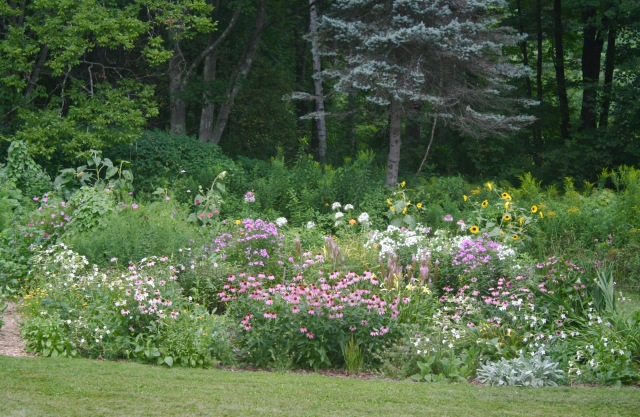


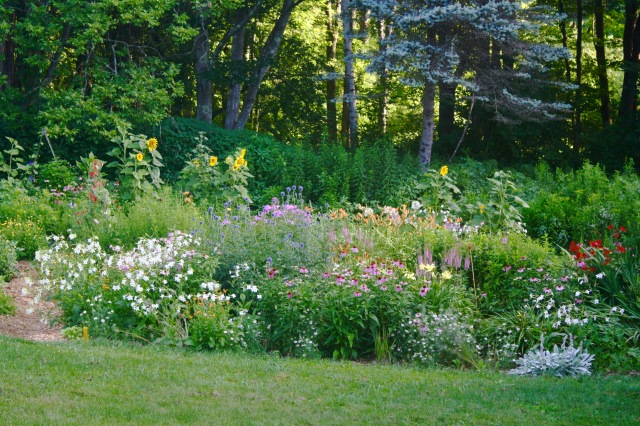
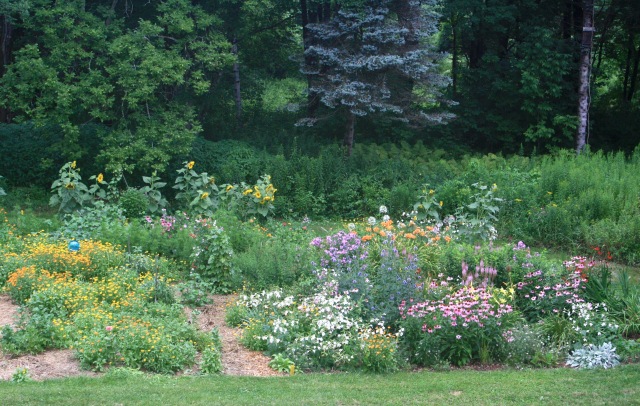
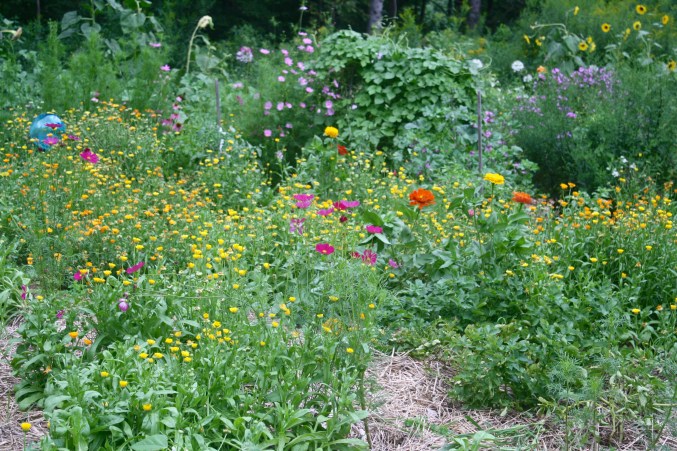 In the back, more cosmos, the sweet peas (Lathyrus odoratus) are overrun with vines of the sky-blue, ivy-leaved morning glory (Ipomoea hederacea). I won’t be planting these two together again. The morning glory is too vigorous and really needs a leaner soil to bloom better. Its weight actually snapped the wooden posts I had and toppled the fence so we had to insert metal fence posts and wire the fence to them. Gardening is an endless learning curve.



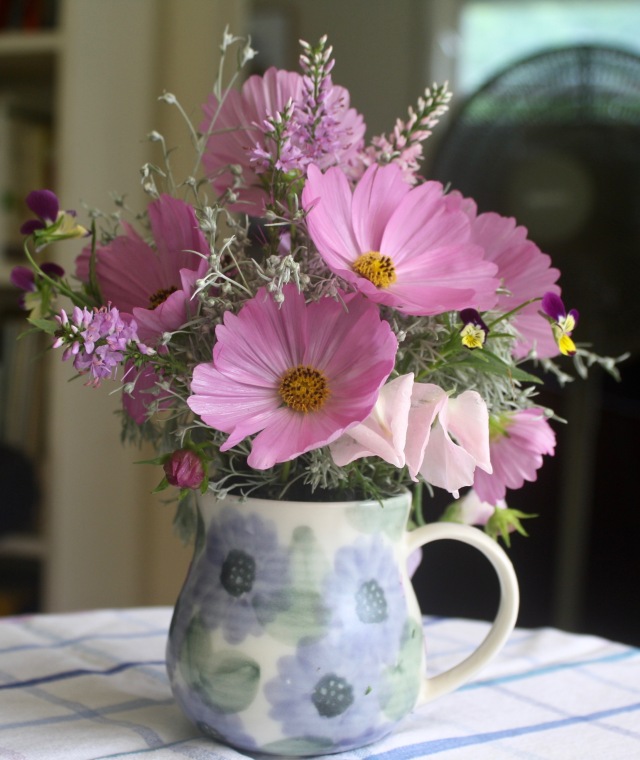 I have two vases to share this week, as both are smaller than my usual arrangements. The first measures approximately 5″ wide x 8″ tall.
 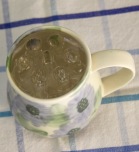 To assist in arranging, I used a vintage glass frog from my mother-in-law’s collection. I was pleased to find that it fit perfectly into my small, hand-painted Ben Thomas Porcelain cup. With wide-mouthed openings,
  frogs come in handy.
 My ‘Silver Mound’ artemisia (A. schmidtiana ‘Nana’) has budded and begged to be used. I love its delicate flowers and lacy foliage.
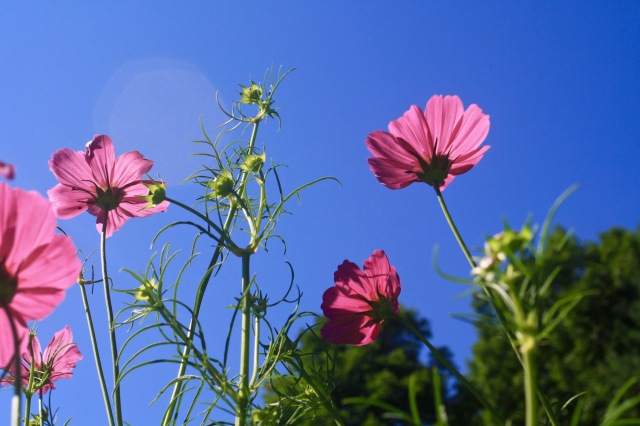
 I thought it would look well with spires of pink and violet veronica (V. spicata). I then added a few stems of Johnny-jump-ups (Viola tricolor), lavender and pink sweet peas (Lathyrus odoratus) and filled in with light pink cosmos (C. bipinnatus ‘Sensation Mix’).
 The second vase is the result of my trimming a top-heavy sunflower that threatened to topple once the flowers set seed. I’ve been enjoying seeing goldfinches visit to pluck ripening seeds, but fat squirrels have found the patch and are ripping them to shreds and scaring off the birds. Naughty squirrels!
 Thanks to Cathy at


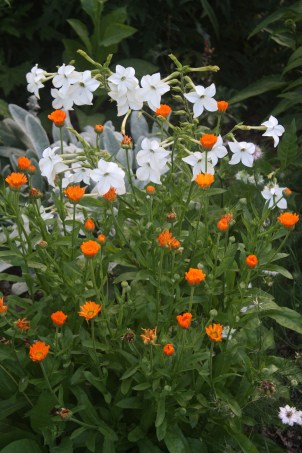 Flowering Tobacco (Nicotiana alata) continue to bowl us over with their honeyed scent every evening, making the nightly rounds a very pleasant thing indeed. Here is one behind an orange calendula (Calendula officinalis). Both self-sow profusely.


 Eliza Waters