Celebrate our tireless friends in the garden this week. We owe them a deep debt of gratitude! Click this link to see what more you can do to help them.

Celebrate our tireless friends in the garden this week. We owe them a deep debt of gratitude! Click this link to see what more you can do to help them.

The daily life of an addict in recovery
In love with gardening
My Life through the Viewfinder/LCD
...but change is certain.
casual scribbles of existence
Exploring sustainability
Awesome Travel Experiences | Best Places To Visit | Great Things To Do
In nature, we find hope, praise and harmony.
A 50 year Anniversary Blog started August 2023, of gardening experience in a harsh zone three climate, daily challenges and successes.
Musings on cats, travel, gardens and life
A Photo Journal
This is where my soul exhales in verse — welcome to my uniVerse.
Notes from the field, essays, and observations.
Poems, Poetry and more
adventures in my gardens
Sewing is my passion
Shelley M. White -Author: Cannabis for Lyme disease // Clinical Herbalist: Lyme disease and co-infections // Yoga Instructor // Nutritionist
"Consider the birds of the air...."
nature + landscape photography / 123 degrees west, 45 degrees north / earth


 Eliza Waters
You bet!
🙂
Yes indeed Eliza!
🙂
Thanks for the post and link. We were just watching the bees and butterflies yesterday and thanking them for the work they do for us. We did not know it was pollinator week.
I’m glad to raise awareness any way I can. We really have to work on getting systemic pesticides like neonicotinoids banned on flowering plants, particularly in the nursery trade. The pollen and nectar from these plants are lethal to insects and birds.
Hi Eliza, when you point to the nursery trade are these big commercial growers like those who supply the home depots of the world who use the neonicotinoids?
Yes, it would be great if folks wrote/contacted the big box retailers asking that they only sell plants from growers that pledge not to use systemics. If we put enough pressure on them by voting with our dollars, they will listen.
I will do my part.
Thank you!
Your welcome.
Here here! I am worried about our pollinators. I am seeing fewer and fewer …
Luckily, I am seeing lots of tiny pollinators and bumblebees, but honeybees, not so much. Butterflies are just starting – I’ve seen small fritillaries, skippers, a viceroy and lots of swallowtails. Fingers crossed for more monarchs this year.
And toes!
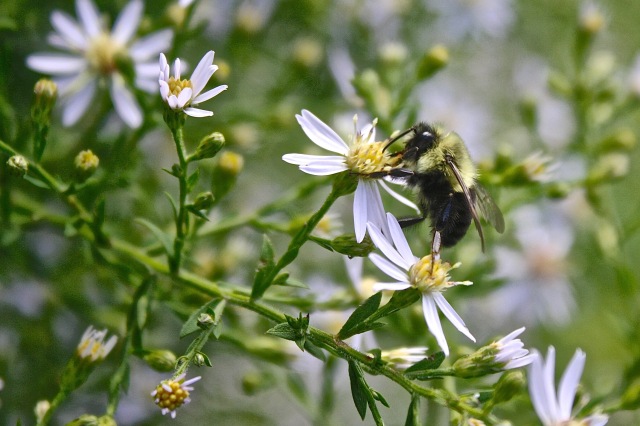
I, too, was just watching a Bumble on my pansy, just outside the kitchen window, bending the flower with its weight. Milkweeds will be blooming, soon, hoping to see a Momarch (or two!) saw an orange butterfly last week, it wouldn’t alight for a photo, I reasoned it was a Viceroy, as the milkweeds weren’t blooming. Eliza….is that Chamomile?
I, too, saw what I figured was a Viceroy on Thurs., reasoning the same as you. The plant with the Carpenter bee is a blue aster (Symphotrichum cordifolium), probably taken in Sept.
🙈monarch🙈
My milkweed is awaiting their arrival!
oh, the joy I have with seeing a blog titled “Pollinator Week” 🙂 . thank you, Eliza!
Yes, indeed. I want to shout it from the rooftops!
Thank you for the link – you know I never would object to having more pollinators around!
We really have to put pressure on the indiscriminate use of pesticides, particularly systemics. They are lethal to bees.
A great reminder, Eliza!
🙂
Well done for promoting this important message Eliza! We are having similar problems here in the UK with drastic reduction in bee and butterfly populations, small mammals and birds. I believe that using chemicals harms wildlife…even those that manufacturers claim are safe! How can chemicals designed to kill one thing be safe for other creatures? Besides… why would anyone want to kill tiny creatures. It’s so easy and inexpensive to create a garden for wildlife with organic gardening methods… then your wild birds will eat the pests. I’ve just posted a short article about flowering plants for Butterflies. We grow plants from all over the world as well as British natives to provide the necessary food and habitat for our bees and butterflies. I bet you are already growing lots of pollinator friendly plants!
Thanks, Gillian. I put out a pollinator buffet like you wouldn’t believe! 😉
That looks like a borer bee, the ones who make holes in our cedar. I know they too are pollinators but I much prefer the honey bees. The numbers of bees has been drastically low compared to other years. And as for butterflies I’ve seen ONE Monarch when I used to see them by the hundreds. I’m also seeing insects in my gardens I’ve never seen before and no they are not the friendly type. Lot of changes, many of which I am so concerned about. I have everything it takes to attract honey bees and Monarchs. Hopefully both will be seen in greater numbers this year! 💗
I hope so, too. Let’s hope that ‘if we build (or plant) it, they will come.’
You’re doing quite a bit to help the bees and keep them happy!
Thank you, Lisa. I love the droning hum of bees in my garden on a warm summer day. I wouldn’t want to be without my buzzing buddies! 😉
Me either. I was going to pull the leeks out las weekend, but the bees were all over the blossoms, so I left them.
That’s <3!
Well, I did not know this. But both Chris and I love it that the 2 varieties of shower trees are profusely in bloom just now. If you were to stand under them, you’d hear the buzzing of bees, as we do in the Duranta planted along our walkway. I am so thrilled that the ubiquitous use of Roundup on these islands has not killed off every bee in sight, for we do see the occasional bee stunned and dying on the ground. Yet to see so many alive! And in our yard! Makes my heart sing!
Glad to hear your yard is buzzing!
Thanks for promoting this message, Eliza. Without our pollinators, where would we be? (And I do love the photo, too :).)
Thank you, Rebecca. At least a third of our food, particularly fruit and curcurbits, depend on bees for pollination. That’s a lot of food!
Pingback: Howlidays: Pollinator Week – Travels with Choppy
Thanks for sharing the link!
Eliza
I so enjoyed reading this and the wonderful pictures. I have seen several of the orange butterfly’s. they seem to be attracted to the wild phlox . Somehow you got dropped from my reader this has happened before I have missed you and glad that you are back on it. This is such an important story, I spread the seeds of milkweed last year but don’t know if any took. I am only pulling out jewel weed so I hope to see some results of the seeds. My best to you.
Hi Carole, thanks for your comment and glad you’re back in touch. With all the rain this spring, the jewelweed certainly is enormous. Maybe you need a scythe – good luck!
Thanks for the interesting links. I am “catching up” a bit late due to pressure on time! It is good to remember that honeybees are not the only pollinators, and also to see encouragement to plant and enjoy native plants and not to use pesticides in our gardens. Thanks for highlighting this important issue. I love watching pollinators, and am surprised to be finding out about ones new to me that I had simply overlooked before.
Thank you, Carol. For myself, once I started looking, I noticed more and more of the ‘minor players’ on the pollinator stage. Nature is endlessly fascinating!