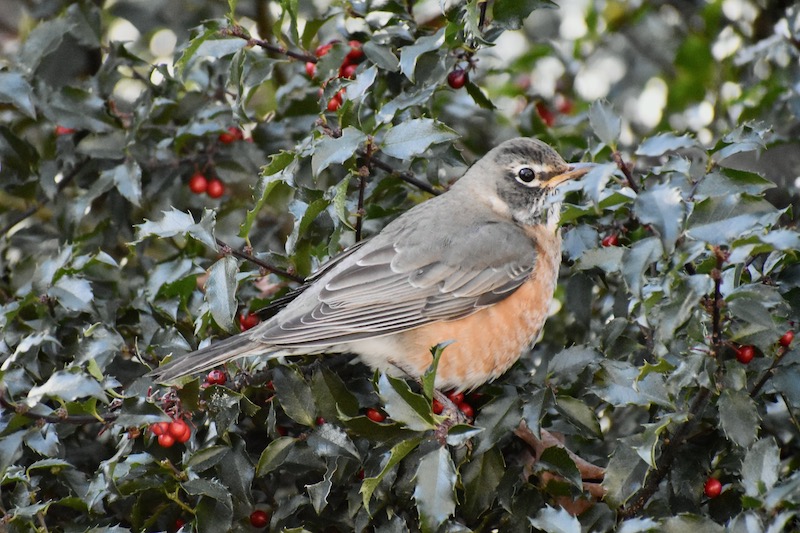
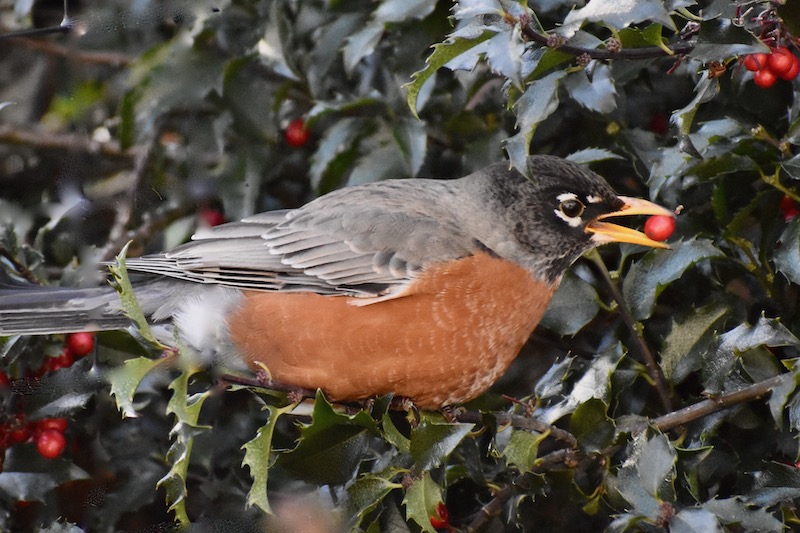
Most American robins (Turdus migratorius) migrate southward in the fall, however many stick around New England for the winter. As they were among the first birds to return in spring, early settlers nicknamed them ‘harbingers of spring.’ For the past couple of decades, I’ve seen robins regularly throughout the winter, I’m guessing due to our milder winters and ease of foraging fruit from shrubs and vines.
A flock of about four dozen descended upon my yard Tuesday and proceeded to gobble up all the crabapples and holly berries in a flurry of wings. It was delightful to see so many!


 Eliza Waters
Robins were my favorite bird as a kid, and still are right up there (with cardinals and mockingbirds). I loved listening to them sing at night in the summer when I had to go to bed before they did! We see migrants here occasionally; I suppose weather, food sources, and so on dictate changing migratory paths.
I love their spring song, always the first to call out before dawn, it makes me smile as I hear that tentative first note or two, like a conductor calling the dawn chorus to order. 🙂
At my prvios home, there was a mountain ash tht was loaded with berries every fall. The robin flock would strip in a just a few hours. They were definitely fun to watch. I’m waiting for the relatiely young mountain ash at my current home to grow enough to be attractive to the robins.
Thanks, Su. Over the years, I’ve planted plenty of shrubs with berries to feed the birds. I think I’m a stop on their nomadic raiding map!
previous…
What a lovely sight that must have been.
I really enjoy their party!
The first choice of robins at my place is cotoneaster berries. They were all eaten before Christmas. They save the holly berries for later.
Yes, my winterberries were gone by Thanksgiving… I had to buy them from TJs for decorating, ha!
The cotoneaster followed shortly after (mostly chipmunks there). Last is the beauty-berry, they must taste better well-frosted!
Beautiful Eliza 🥰
Thank you, Karen. The look like healthy birds, too. Always a happy sign. 🙂
Four dozen—wow!
Four dozen—wow!
IKR? I did a quick count, but with them fluttering everywhere, there may have been more. It made my day, for sure. 🙂
What a wonderful experience! Watching a flock of robins in action must have been a delightful sight. These birds are known for their energy and vivacity, and watching them feast on the berries in your garden surely brought a special touch to the day.
Greetings.
Gracias!
🤗🤗
What a lovely sight to enjoy in winter when the landscape isn’t nearly as interesting with a nice spot of color.
Their piping reminds me of nesting season, they definitely cheer me up!
Ah, so climate change does have its advantages then kind lady 🤣❤️🙏
IKR? 😉
These are so delightful.
Thank you, Flavia. They really cheer me on this cold wintery day with a windchill hovering around -20C!
Oh my – that is cold! Sending you warmth from here.
Thanks!
That’s a LOT of Robins…at least the worms were safe on this trip!
We have no snow left, so they are able to forage in the leaves if they want, but they have eaten just about every berry out there. I suspect they will come back and finish the rest today.
So interesting and unusual to see robins, usually pictured perched on branches covered in spring blossoms, set in a classic winter background of holly leaves and berries. Lovely captures, Eliza!
Thank you, Barbara!
They know where the goodies are!!
We are enjoying a parade of robins and red wing blackbirds and starlings right now along with the usual winter birds. Even the Canadian geese hang around here year round.
For sure, and I love gardening for wildlife. They were nice enough to wait until Christmas was over before they started eating the decorations! 😀
Berry beautiful captures, Eliza!
🙂 Thanks, Donna!
Sounds like they enjoyed a very good feast. I’m sure they need that with these cold temps.
Yes, so glad to provide the buffet!
A wonderful post!
Thank you, friend! 💕
The opposite is happening here and Robins have been spending the summer. I have seen nests and I had a family in my yard during the summer. I think many animals will learn to adapt to changes.
I read that many stay put year round, do you see them all year?
Yes, I have seen them in the summer as they are not flying north. They do seem to like wooded areas and big shady live oak trees where the shade drops the temperatures some. There are not as many as you see up north. The Robins’ calls always brings back childhood memories. They would be getting their last meal as we played outside.
Nothing quite like seeing a whole flock of robins descend on your yard! Kudos to you for planting hollies and other goodies to keep them fed during the winter. I don’t think all our robins migrate south either. I know I’ve seen them when it’s still considered winter.
We have them in winter, as well. I remember, during one of my walks, there must have been at least one dozen in one tree. I love them.
They can form sizable flocks in winter, this was quite a gang! 🙂
Indeed. And how lovely to be able to capture them with our lenses!
No robins here until April … love their cheeery songs 😍
Same here, although no springs songs now, just scolding cheeps!
lol 😉
Hi Eliza. Aren’t they pretty? Quite different to our robins in Europe. And I think ours tend to not gather in groups. Must have been a real treat.
MJ
Being about twice the size of European robins, they create quite a ruckus when they show up en masse. Definitely a treat to see.
They’re such pretty birds. I offered a bird-related post today myself.
https://krispgarden.blogspot.com/
Agreed. Thanks, Kris!
Lovely images. Robins are gone in Montreal so we will see them again in the Spring. (Suzanne)
Thanks, Suzanne. Interestingly, another reader in Montreal reported seeing some. I guess it perhaps depends on the food supply and suitable vegetation for roosting.
You are probably right but I don’t remember seeing robins in winter though I must admit that we aren’t often in Montreal in winter!
Cute. Your robins look a bit different to our cheeky little British ones.
Thanks, Jill. They are also twice as large and would never accompany us in the garden like yours do. 🙂
Fine images. I didn’t realize they migrated, I’m used to seeing them this time of year.
Thanks, Tom. When I was a child, we never saw them here in WMA. I remember visiting SE MA/RI in the mid-70s and was astonished to see them overwintering there.
Beautiful pics. I haven’t seen as many winter robins as usual this year, so this was a treat!
Thank you, Julie. All your robins must be out this way! 😉
That must have been such fun to watch! 😃
They gobble up berries faster than you can blink! 😀
I’ve rarely seen one in winter, how wonderful! I love the first shot 😊
Thank you, Belinda. They are a treat, reminding me that spring will come again.
Well photographed. Down here it’s most conspicuously cedar waxwings that devour the native holly berries, but one time I saw robins gobbling non-native berries.
Thanks, Steve. Yes, they do eat and spread the non-natives as well. But the horse is out of the barn there.
New Year’s day there was a large group of Robins feasting on my winterberries. Always nice to see them.
They remind us that summer will come again. 🙂
Beautiful photos.
Thank you, Diana!
Nice photos, Eliza. One year I had a flock of robins combined with waxwings descend on my holly trees. I loved all the noise they made and the preciseness with which they cleaned off the berries. They usually show up in February.
Thank you, Rebecca. It feels like a big party when they show up!
Nice shots. Based on the degree of their coloring it looks like a female in the first photo and a male in the second.
Thanks, David. I thought that at first, too. But I think the first is a juvenile as it has a short tail. 🙂
Thanks for the info Eliza, I’m always learning something new on WordPress. Do you think this is and older juvenile on the cusp of adulthood and therefore does not have the dark spots on the breast that characterize juveniles?
My guess it may be on the cusp of adulthood, possibly female. But I’ll admit I’m not a pro here! 🙂
Beautiful Eliza. Our robins – which look a little different to yours – are with us all year round and are one of the few birds who sing all year round too.
Thanks, Andrea! I’ve never seen a UK robin, but find them quite charming.
In Swedish it is Rödtrast. I sometimes see them at my garden.
Cool! These visitors moved on the next day, after having eaten just about every fruit in the yard!
We so rarely see Robins in our area. They’re delightful. Thank you for sharing the origins of ‘harbingers of spring. Fun!
Thank you, Alys. They can form sizable flocks in winter, but in summer breeding season, they can be quite territorial, so our yard will rarely have more than a pair or two. This was quite the gang and not a berry is left!
I don’t see Robins very often, but I sure like these two photos. That berry looks delish!
Thank you, Tina. They were having a grand party there!
These are awesome shots Eliza! Couldn’t ask for a better backdrop!
Thank you very much, I was lucky this bush was right next to the house!
The berries provide such a pretty color contrast. I remember one day last year when I saw about two dozen robins in our front yard and I thought that was a lot. Four dozen must have been a sight to see. 😊
Thanks, Pepper. They made quite a ruckus, too. Fun to watch!
I love all birds. I don’t see them in Aussie
I can’t imagine my life without birds, they really liven up my days. Best to you, Deepa!
Beautiful photos, Eliza.
It’s always fun to come across a flock of robin and watch them gorge themselves on whatever berries they can find.
Thanks, Tanja. And gorge they do! After a day or so, not a berry was left!
That tends to happen.
Per design. 🙂
Love the winter robins and watching them enjoy the berries!🙂
Man, they cleaned my bushes in very short order!